
What Is a Traffic Management Plan (TMP) and When Do You Need One in New Zealand?
A Traffic Management Plan (TMP) is a legal document that sets out how you will keep road users and workers safe when your activity affects the normal operation of the road reserve. A TMP is required whenever your work affects a road, footpath, cycle lane, or shoulder/berm, and in almost every case it has to be approved before any cones go out. Under the New Zealand Guide to Temporary Traffic Management (NZGTTM), a TMP is no longer a standard layout with your details filled in. It is risk focused and prioritises how identified risks will be controlled within your site.
What is a Traffic Management Plan?
A TMP is your documented plan for managing traffic, pedestrians and workers while an activity takes place in the road corridor. It describes the site, the risks, the controls, the physical layout and provides contingencies if something was to go wrong
The important thing to understand about ownership: the TMP belongs to the applicant, not the council. The road controlling authority (RCA) reviews and approves it, but you own it and you implement it. It is an operational document that the crew works from, not a form you submit and forget.
When is a TMP required in New Zealand?
A TMP is required whenever an activity changes the normal operating conditions of a road. The road corridor runs from one property boundary to the other, which means the berm, the footpath and the carriageway are all included, and work does not have to be on the seal to need a plan.
Activities that commonly require a TMP include:
• Work on the carriageway. Excavation, utility connections, resurfacing, drainage, line marking, and anything narrowing or closing a lane.
• Work on the footpath or berm. Trenching, vehicle crossings, tree work and landscaping that displaces pedestrians.
• Obstructions in the corridor. Scaffolding, skip bins, containers, cranes, concrete pumps and scissor lifts placed on the road or footpath.
• Driveway and vehicle crossing construction. Small residential jobs still need a plan if the work or the vehicles occupy the corridor.
• Events. Runs, parades, markets, festivals and film work that close or restrict a road.
• Work on private property that changes traffic outside it. A construction site with heavy vehicles crossing a footpath is the usual example.
One rule worth knowing before you programme the work: approval is required before any temporary traffic management is placed in the corridor. Putting cones out while the application is still being processed is not a shortcut, it is a non-conformance.

What is included in a TMP?
A TMP submitted under NZGTTM needs to show both what you are doing and why the controls you have chosen are appropriate for that site. The core components are consistent across RCAs, even though the templates differ.
Proforma
Diagrams
Supporting Risk Assessment
Peer review from PCBU (and their signature of approval)
Site details and road environment
Location, route position, the activity, the dates and times, the road environment and its category, traffic volumes and speed environment, and any features that change the picture: schools, bus routes, driveways, intersections, cycle lanes.
Risk assessment and risk register
This is the part that defines an NZGTTM plan. Each hazard is identified and linked to a control, so the plan shows the reasoning rather than just the outcome. Several councils have stated that a TMP submitted without a risk register and risk assessment will be treated as a CoPTTM based plan by default, for the life of that plan. You cannot decide on site later that you were operating under NZGTTM all along.
Traffic management diagram
The layout drawing showing the physical setup and the movements associated with the work, including the setup and pack down stages, not just the steady state. The stages either side of the work are when a good proportion of incidents happen, which is why they belong in the drawing.
Control methods, staffing and equipment
How traffic will be managed through or around the site: manual control, portable signals, shuttle operation, detour or full closure, along with the devices required and the supervision arrangement on site.
Contingency, monitoring and contacts
What happens when conditions change: weather, an incident, an emergency vehicle needing through, the work overrunning. Plus, how the site will be monitored and who to call, named and reachable, during the hours the site is live.
Who can prepare a TMP and who approves it?
A TMP must be prepared by someone with recognised temporary traffic management design competency and approved by the road controlling authority for that road. NZTA is the RCA for state highways. For local roads it is the district or city council.
On competency, councils have generally been naming a practising Temporary Traffic Management Planner (TTMP) warrant, the relevant NZQA unit standard for developing a traffic management plan, or a temporary traffic management design micro-credential. Since the NZTA warrant system was phased out from 1 November 2024, the balance is shifting towards NZQA registered qualifications, unit standards and micro-credentials, and away from warrants and internal company systems.
When NZTA assesses a TMP it looks for evidence that the designer holds credible training or equivalent experience for their function, that a supervisory onsite role will be filled by someone with the right competencies, and that onsite supervisors have a process to confirm the plan is appropriate and is being followed.
What is the difference between a TMP a CAR and a WAP?
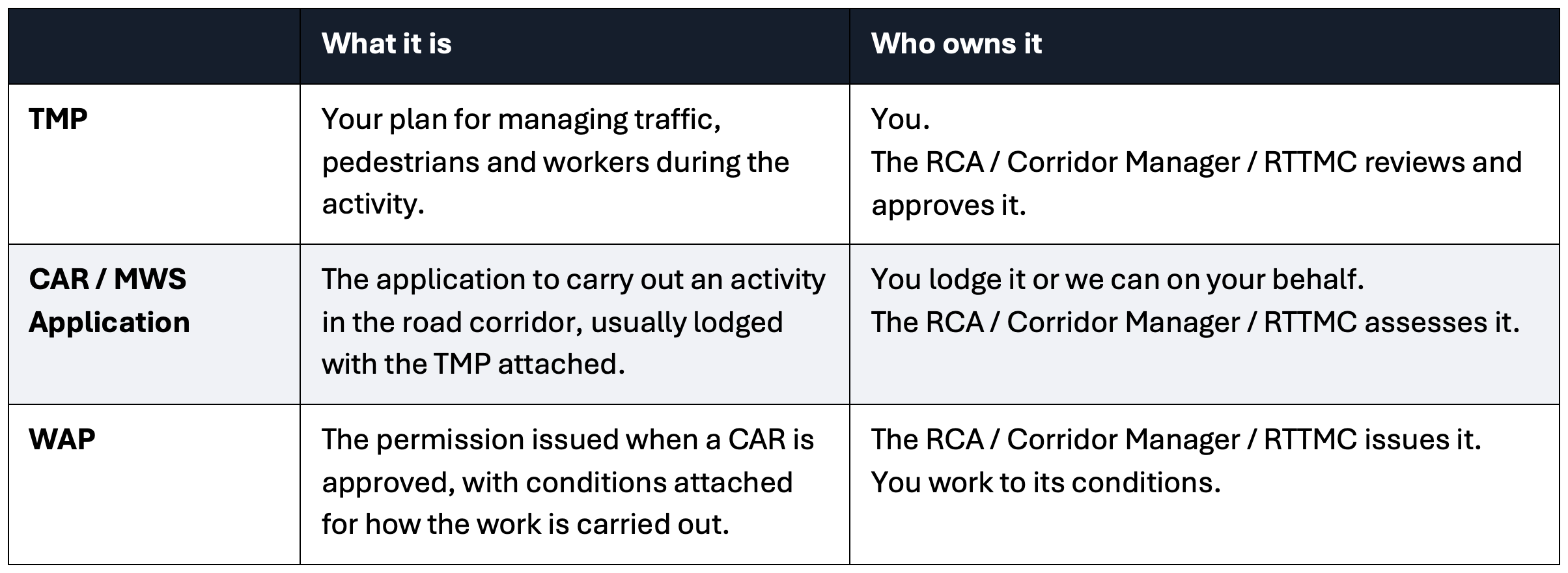
These three get used interchangeably and they are not the same thing. The TMP is how you will manage traffic. The Corridor Access Request is your application to occupy the corridor. The Works Access Permit is the permission you receive when that application is approved.
Lodgement channels differ by authority. Corridor Access Requests are generally lodged through Submitica or the before Udig service, while NZTA takes traffic management plans for state highways through myWorksites. For larger state highway projects, an Early Access Request lets you start the conversation with NZTA before the full plan is ready, which is worth using when network impact is likely to be significant.
How long does a TMP take to prepare and approve?
It depends on complexity and on the authority, and anyone quoting you a single number for the whole country is guessing. NZTA grades submissions by complexity and network impact: straightforward, low impact plans need less detail and are processed sooner, while complex projects may need additional evidence or a meeting before approval.
Three things reliably slow an approval down:
Incomplete information. A missing risk register, an unclear diagram or a layout that does not match the described activity all trigger a request for more information, and the clock restarts.
Late lodgement. Councils set notice periods, and a plan lodged inside them competes with everything else in the queue.
Moratorium periods and network conflicts. There are times of year when work cannot proceed on or near certain roads, and your approved dates also must fit around everyone else booked into the same stretch.
If your dates change after approval, the booking must be updated. A TMP is only valid for the approved time and space, so extra days, fewer days or different hours all need to go back through rather than being absorbed quietly on site.

What changed under NZGTTM?
NZGTTM replaced the Code of Practice for Temporary Traffic Management (CoPTTM) as the preferred guidance, moving the industry from a prescriptive approach to a risk based one. NZTA stopped updating CoPTTM from 1 November 2024, and from 1 October 2025 NZGTTM must be applied to all of its maintenance and capital projects.
For anyone writing or reading a plan, the practical differences are these:
Risk first, layout second. The plan starts from the risks at your specific site rather than from a standard drawing that matches the road type.
More responsibility on the PCBU. NZGTTM is written to help persons conducting a business or undertaking meet their duties under the Health and Safety at Work Act 2015. Choosing a compliant looking layout does not transfer that duty.
Competency proven differently. With the warrant system phased out, businesses have to satisfy themselves and the RCA that their people are competent for the road environment they are working in.
Uneven adoption across the country. RCAs are transitioning on their own timelines. Some accept plans under either approach for now, some have set cut-off dates after which only NZGTTM based plans are accepted, and a few had not formally adopted it at all. Confirm the position for your specific site before you draft.
TMP design services from TMNZ
TMNZ operates a team of designers for the development and fast turnaround of Traffic Management Plans, each compliant with NZTA standards, in support of customer works across all regions within NZ.
Because TMNZ lodges plans all across New Zealand, the team knows how individual authorities are handling the NZGTTM transition, which is usually the difference between a plan approved first time and one that comes back for more information. Contact our Design Team here.
Frequently asked questions about Traffic Management Plans
Do I need a TMP for work on private property?
Sometimes. If the activity changes traffic on the road outside, for example heavy vehicles crossing a footpath into a construction site, a plan is generally required even though the work itself is on private land.
Can I reuse a TMP from a previous job?
Not as it stands. Under a risk-based approach the plan has to reflect the specific site, and a reused plan usually shows: the risks do not match the location, and the diagram does not match the activity. Previous plans are useful as a starting point for the designer, not as a submission.
Do I need both a TMP and a CAR?
In most cases yes. The CAR is the application to occupy the corridor and the TMP is generally lodged with it. Requirements vary by authority, so check what your RCA expects for the specific activity.
What happens if the work changes after the plan is approved?
Changes need to go back through rather than being made on site. Different dates or hours mean updating the approved booking, and changes to the activity or the layout usually mean an amended plan. On site adjustments are possible under a risk-based approach, but they have to follow a documented process.